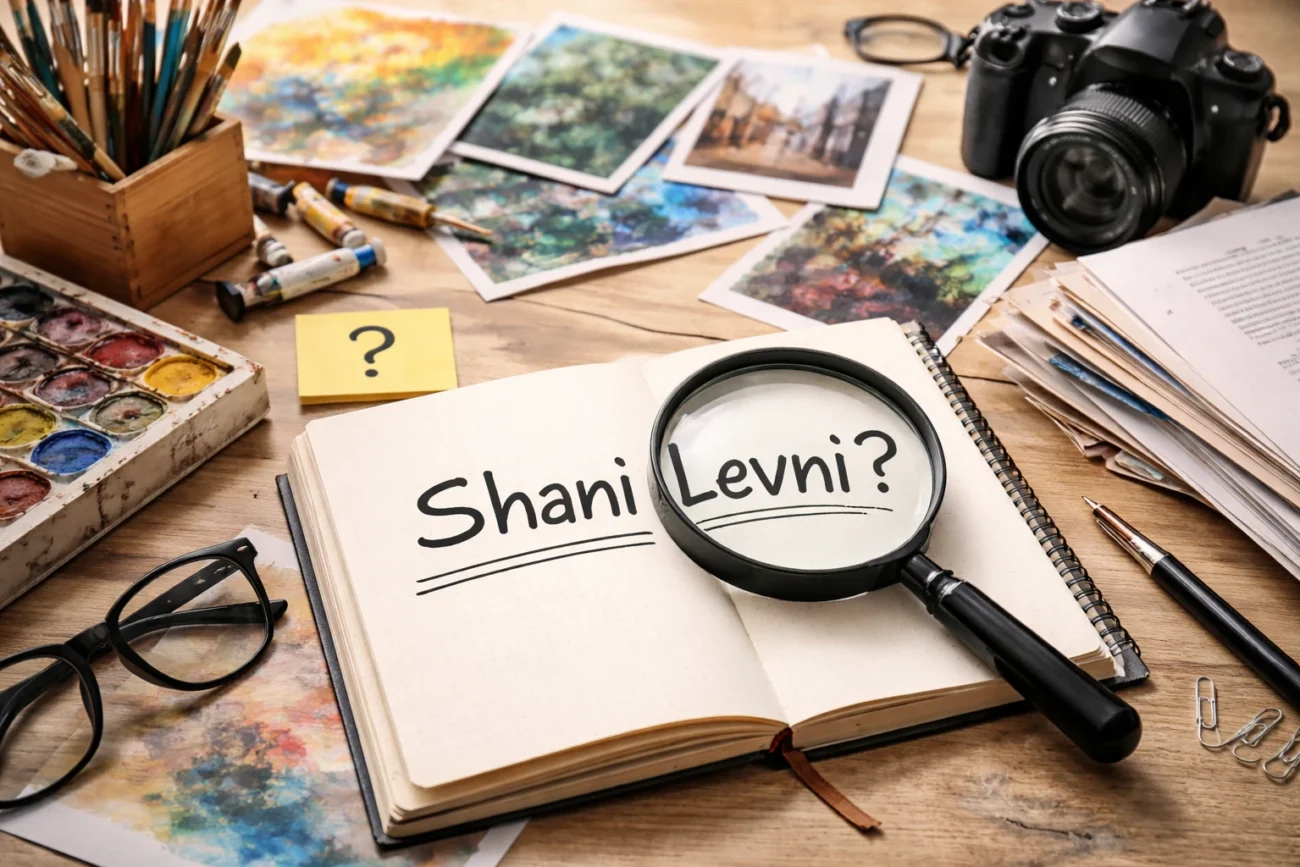
Search for “Shani Levni” and you’ll find a surprisingly consistent story. The name is often tied to an Israeli contemporary artist, someone working in mixed media, exploring identity, memory, and place. Several sites describe exhibitions, education at respected institutions, and even a nonprofit initiative tied to her work.
But here’s the thing. When you start checking those claims against primary sources—museum listings, gallery records, institutional archives—the trail becomes much thinner. The same details appear again and again across different websites, often with similar wording, but without clear independent confirmation.
That doesn’t mean the person doesn’t exist. It does mean the public record is murky. And that makes this less of a straightforward profile and more of a reporting exercise: what do we actually know about Shani Levni, and what’s still unverified?
The Online Story About Shani Levni
Across dozens of websites, a familiar biography appears. Shani Levni is described as a contemporary artist from Israel, often linked to Tel Aviv. The narrative usually begins with a childhood shaped by cultural contrast and ends with a career focused on themes like identity, displacement, spirituality, and memory.
Many of these profiles say she studied at the Bezalel Academy of Arts and Design in Jerusalem, one of Israel’s most respected art schools. Some go further, claiming she pursued advanced studies in Berlin, placing her within a broader European art context.
The work itself is described in similar terms wherever you look. Paintings, installations, and mixed-media pieces that blend traditional materials with modern techniques. There’s frequent mention of symbolic imagery—trees, light, fragmented text—and an emphasis on emotional storytelling through visual form.
Several pieces are named repeatedly: “Whispers of the Olive Tree,” “Between Earth and Sky,” “Letters Never Sent,” and “The Weight of Light.” These titles appear across multiple sites, often presented as key works in her portfolio.
At first glance, it reads like a complete and credible artist biography. But repetition is not proof.
Where the Evidence Gets Thin
When you move beyond those profile pages and look for independent confirmation, the picture changes. Searches through major museum databases, gallery listings, and institutional archives do not clearly verify many of the claims attached to Levni’s name.
That includes some of the most prominent assertions. Exhibitions at well-known venues like the Tel Aviv Museum of Art or participation in events like the Jerusalem Biennale are often mentioned, but they are not easy to confirm through official records. In the art world, exhibitions typically leave a paper trail—catalog listings, press releases, archived event pages—and those are not readily visible here.
The same issue applies to education claims. Bezalel Academy maintains records and alumni connections, and while not every graduate has a public-facing profile, the absence of any easily verifiable link raises questions. The Berlin graduate study claims are even harder to trace, often lacking a named institution.
So what does this actually mean? It doesn’t prove the claims are false. It does suggest they are not strongly documented in places where you would expect them to be.
The Pattern of Repetition
A closer look at the websites discussing Shani Levni reveals something else. Many of them are relatively recent, often published in late 2025 or early 2026. The language is polished but generic, and the structure of the articles is strikingly similar.
They tend to follow a familiar pattern: early life, education, artistic style, notable works, exhibitions, and social impact. The phrasing often overlaps, sometimes almost word for word, even when the sites are unrelated.
That kind of consistency can signal shared sourcing. It can also signal content recycling, where one article becomes the template for many others. In some cases, smaller blogs and magazine-style sites appear to be echoing each other rather than reporting independently.
There’s a catch, though. Once a narrative like this takes hold online, it can start to look like consensus. Readers see the same details repeated across multiple sources and assume they’ve been verified. But repetition can create the illusion of credibility without actually providing it.
The Question of Identity
One complicating factor is the possibility that “Shani Levni” may not refer to a single, clearly documented public figure. Some references suggest the name could be linked to more than one identity online, though those claims themselves are not deeply substantiated.
That kind of ambiguity is not unusual in digital spaces. Names can be shared, adapted, or even constructed for specific purposes. In the art world, pseudonyms and curated identities are also part of the culture, especially in experimental or emerging circles.
Still, without a clear anchor—an official website, a verified social media presence, a gallery representation page—it becomes difficult to tie all the available information to a single, confirmed individual.
The Reported Themes of Her Work
Even with the uncertainty around sourcing, the descriptions of Levni’s supposed work follow a consistent thematic thread. Identity appears at the center of nearly every account. Not identity as a static label, but as something fluid, shaped by culture, memory, and personal history.
There is also a strong emphasis on displacement and belonging. Several descriptions suggest that her work explores what it means to move between places, whether physically or emotionally. That theme is common in contemporary Israeli art, where questions of history, geography, and identity often intersect.
Spirituality is another recurring element. Light, shadow, and symbolic imagery are said to play a central role in her visual language. These details point toward a style that aims to evoke feeling rather than deliver direct narrative.
But here’s where caution matters. These themes appear across many profile pages, yet they are not tied to verifiable exhibitions or catalog essays. Without primary sources, they remain descriptions rather than confirmed critical interpretations.
The Root Collective and Social Impact Claims
Another part of the online narrative involves something called “The Root Collective,” described as an initiative connected to Levni’s work. The project is often framed as a blend of art, community engagement, and social activism.
The idea is compelling. Artists collaborating with marginalized communities, using creative expression as a tool for dialogue and change. It fits well within current trends in socially engaged art.
That said, concrete details are scarce. There are no widely cited organizational records, official program descriptions, or independent reports documenting the initiative’s activities. Without those, it’s difficult to assess whether The Root Collective is an active project, a conceptual idea, or something that exists primarily within online profiles.
Why the Name Is Showing Up Now
One of the more interesting aspects of this story is timing. Most of the content about Shani Levni appears to be recent, clustered within a relatively short window.
That raises a reasonable question: why now?
There are a few possible explanations. One is that Levni is an emerging artist whose online presence is just beginning to take shape. Another is that the name has been picked up by content sites looking to capture search traffic around lesser-known figures.
The second explanation fits the pattern seen across many of the current results. Articles are well structured, keyword-focused, and often published on platforms that cover a wide range of unrelated topics. They read more like SEO-driven content than original reporting.
The numbers tell a different story than the narrative. There are many articles, but very few sources.
What Would Confirm the Story
If Shani Levni is indeed a working contemporary artist with the background described online, there should be clear ways to verify it.
An official website would be one of the strongest indicators, ideally with a portfolio, exhibition history, and contact information. Representation by a gallery would provide another layer of credibility, especially if that gallery has a public track record.
Museum and biennale listings are also key. Even emerging artists who participate in group exhibitions usually leave behind digital records. Catalog essays, press coverage, or interviews in established publications would add further weight.
So far, those pieces are not easy to find. That absence doesn’t close the case, but it does shape how the story should be told.
The Broader Context: How Online Profiles Take Shape
The situation around Shani Levni is not unique. The internet is full of names that exist in a gray area between documented public figures and constructed profiles.
Content ecosystems reward volume and consistency. Once a topic starts generating interest, more articles appear, often drawing from the same pool of information. Over time, the repetition creates a sense of authority.
But authority built this way can be fragile. Without primary sources, it rests on a feedback loop rather than independent verification.
For readers, the challenge is knowing when to trust what they see. For writers, the responsibility is to resist filling in gaps with assumption.
Frequently Asked Questions
Who is Shani Levni?
Shani Levni is widely described online as a contemporary Israeli artist working in mixed media. Many websites present similar biographies and artistic themes, but independent confirmation from major institutions or primary sources is limited.
Is Shani Levni a real artist?
There is no clear evidence that the name refers to a fabricated person, but the available information is not strongly backed by verifiable records. The repeated claims across multiple sites do not, on their own, confirm a documented public career.
What is Shani Levni known for?
According to online profiles, Levni is known for work exploring identity, memory, and spirituality through painting and installation. However, specific works and exhibitions tied to her name are difficult to verify through independent sources.
Did Shani Levni study at Bezalel Academy?
Several websites claim she studied at the Bezalel Academy of Arts and Design in Jerusalem. At this time, that claim is not easily confirmed through publicly accessible institutional records.
Has Shani Levni exhibited in major galleries or museums?
Some profiles mention exhibitions at well-known venues such as the Tel Aviv Museum of Art and participation in major art events. These claims are not clearly supported by readily available official listings.
What is The Root Collective?
The Root Collective is described online as a social initiative connected to Levni’s work, focusing on art and community engagement. There is limited verifiable information about its structure, activities, or existence beyond those descriptions.
Conclusion
The story of Shani Levni sits at the intersection of curiosity and caution. On one hand, there is a detailed and consistent narrative about an artist whose work explores identity, memory, and belonging. On the other, there is a lack of strong, independent evidence to support that narrative in the places where it would normally appear.
That tension matters. It highlights how easily a biography can take shape online, even when the underlying documentation is thin. It also shows why verification still matters, especially in an era where information spreads faster than it can be checked.
For readers, the takeaway is simple but important. When you encounter a name that appears across multiple sources, look for the foundations beneath it. Museums, galleries, official sites, and established publications tend to leave clearer trails than blog-style profiles.
As for Shani Levni, the door remains open. With stronger sourcing, the story could shift from uncertainty to confirmation. Until then, the most honest answer is also the most useful one: this is what’s being said, and this is what can actually be verified.
